As Escudilla continues to explore new project opportunities, our current focus is on Botswana.
Botswana Project Finance for Permanence
Project Finance for Permanence (PFP) adapts an infrastructure finance technique for conservation. Instead of funding protected areas through a series of short-term grants, a PFP assembles all commitments needed to sustain a national or regional conservation system — government budget, philanthropic capital, policy and legal reform — and brings them together in a single closing transaction. Nothing is released until everything is in place. The Botswana PFP, in cooperation with the Pew Charitable Trusts of Enduring Earth, expands on the Botswana Community and Conservation Initiative, formed by Wild Entrust, Natural Selection Conservation Trust, and Escudilla International Conservation.
How the model works — Conservation systems tend to fail for financial rather than technical reasons. Management plans exist, but the funding to staff and run them arrives in short-term increments, so capacity is built and lost repeatedly. A PFP is designed to break that cycle by making the money conditional on the conditions that would otherwise erode it.
— A single close. All parties sign at once. Funders commit only if the government commits; the government legislates or reforms knowing the finance is secured. The interdependence is the point — it removes the first-mover risk that stalls large conservation agreements.
— Conditions precedent. Disbursement is tied to defined milestones — legal designation of areas, governance arrangements, staffing levels — rather than to good intentions. Commitments that cannot be met are not closed on.
— A transition fund, not a subsidy. The capital is deliberately time-bound. It funds a defined transition period during which management systems, institutions and domestic revenue are built up, and it is designed to taper as those take over.
— An independent trust. trust holds and disburses funds with its own board and investment policy, separate from both the government and the funders, so decisions about money are insulated from the annual budget cycle and donor turnover.
— A durable government commitment. The government undertakes to sustain and usually to increase its own conservation spending over the term. Philanthropic capital pays for the increment, not the baseline.
The Botswana PFP — Botswana holds one of the most intact large-mammal systems remaining in Africa, anchored by the Okavango Delta, the Chobe–Linyanti system, the Makgadikgadi and Nxai Pans, the Central Kalahari Game Reserve, and the Kgalagadi Transfrontier Park, and connected westward and northward into the wider KAZA landscape. The system is not under acute threat of conversion so much as of quiet attrition: protected areas are understaffed and under-maintained, corridors are closing due to fencing and agricultural expansion, and human–wildlife conflict is rising in the settled areas between the parks.
A PFP is now being prepared to address that. It is being developed with the Government of Botswana, international conservation philanthropic funders, and Botswana-based implementing NGO partners. Its scope covers six districts — Ngamiland, Okavango, Chobe, Central, Ghanzi, and Kgalagadi — organized into four implementation clusters that phase in at different rates based on institutional readiness.
The program is built around three outcomes — biodiversity conservation, community well-being, and climate resilience — supported by work on sustainable financing mechanisms to sustain the system after the transition period ends. An independent Conservation Trust Fund will hold the capital, combining a sinking fund for the transition with an endowment for obligations that persist beyond it.
Where it stands — The Botswana PFP is in design. Its governance framework, results architecture, sequencing, and budget are in draft and under negotiation between the parties; the total commitment and its split between transition and endowment funding are not settled and will be finalized at close. Escudilla International Conservation provides technical advice, alongside district institutions, community organizations, and implementing partners who will carry the program forward once it closes.
The Kalahari San Transfrontier Trail and Wildlife Corridor Initiative — Inspired and informed by the San of the Kalahari. In cooperation with the Wisdom Academy, a Nanofasa initiative
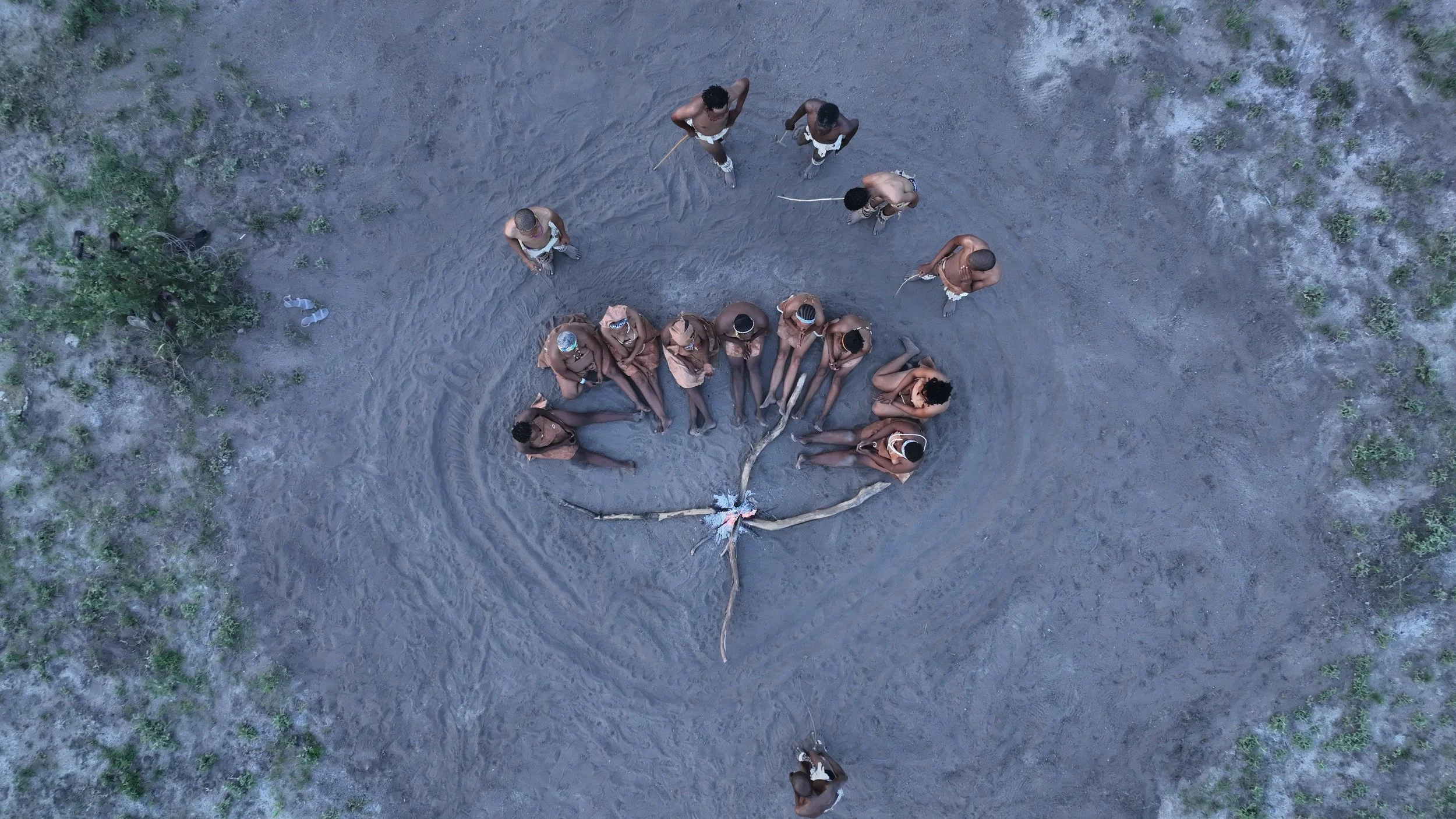
A wildlife corridor and cultural route across the Kalahari, walked and held by its First People. A road older than roads. Long before there were borders or fences in the Kalahari, there were paths --- between water, between seasons, between people. The Kalahari San Transfrontier Trail is a proposal to protect those paths, to reopen the wildlife corridors that follow them, and to establish the San as the recognized custodians and principal beneficiaries of the landscapes they have never left.
The idea — The initiative aims to protect more than a thousand kilometers of historically significant routes across Botswana's Kalahari, reconnecting the corridors linking the country's largest protected areas. It is proposed as a component of Botswana's Project Finance for Permanence—a mechanism designed to fund conservation in perpetuity rather than through grant cycles.
What distinguishes it is not the corridor but the custodianship. The Kalahari's conservation estate has largely been managed around the San rather than with them. Botswana's National Development Plan now names that exclusion as a governance failure to be corrected. This initiative gives that commitment practical form: San communities hold authority over their own landscapes, are employed in their protection, and earn from the visitors those landscapes attract.
The land and its people — The Kalahari is home to globally significant populations of desert-adapted wildlife --- eland, gemsbok, wildebeest, springbok, lion, cheetah, wild dog, and brown hyena --- in some of Africa's largest and most intact protected areas.
The San have lived here long before any of it was mapped. Genetic evidence places the divergence of the Khoe-San lineage from other modern human populations in southern Africa at roughly 250,000 to 300,000 years ago. Theirs is not a story of arrival but of continuity. Some 27,100 San people across fourteen distinct groups live in the districts this initiative would serve, holding ecological knowledge of water, plants, animals, and seasons that no survey can replicate—and, in the trance dance, one of the oldest living healing traditions on earth.
What the initiative builds
· Documented heritage. Participatory mapping of ancient routes, waterpoints and sip-wells with elders, women and youth, recorded oral histories, and a geospatial archive the communities themselves hold.
· San Guardians. A resident, San-appointed cadre caring for water points, wildlife and corridors, with training credentialled so that it holds value beyond the reserve.
· Cultural Camps. Places where language, craft, tracking and ceremony pass between generations --- and the entry point into Guardian work rather than a program standing on its own.
· A network of Wisdom Centers. Beginning with the Ju|'hoansi Wisdom Center at the Makgadikgadi Pans, built on the Wisdom Academy already operating there, and extending across the Kalahari.
· The Kalahari Camino. A walking route led by San trackers and elders, operated through a Botswana company that protects San community equity from the start.
· Recognized custodianship. A block-by-block strategy --- partnership, community application, co-management or equity, chosen to fit each place --- aimed at land and custodianship outcomes that hold in law.
How it would be governed — Two structures, deliberately separate. A Botswana tourism company holds the commercial vehicle. A San-led custodial body holds the purpose: the cultural protocols, the cultural and intellectual property, and the principles governing access, tourism, and research. The company operates; the custodial body protects what the operation exists to achieve.
Underneath both sits the N!Ore model, the traditional San system of land stewardship. Each group retains authority over its own landscape. No single group or organization speaks for the rest. That is a structural commitment rather than an aspiration, and it shapes how consultation, benefit-sharing and negotiation are designed throughout.
How it begins — Someone has to walk the route. The founding Camino is conceived as both pilgrimage and working expedition—led by San trackers and elders, identifying old paths, water, seasonal movement, places of memory, and workable walking distances. It is both the beginning of the route and the beginning of the evidence needed to secure it.
The international record is consistent on the sequence: guardian programs usually create a protected area, not what follows. A functioning San institution on the ground before financing is agreed is a different proposition from one promised in a work plan.
The Great Gathering — Proposed as the ceremonial heart of the route: a gathering of San healers, elders, dancers, singers, and young apprentices from Botswana and Namibia, hosted at the Makgadikgadi. Its first purpose is transmission --- elders teaching younger healers while elders are still available to teach. It would be convened for the San who attend it, under protocols the healers set, with any record of it belonging to them.
Where it stands — The initiative is in the design phase. Consultation with the communities concerned is ongoing and governs everything that follows: no route is published, and no landscape is presented as part of the Trail, before the people connected to it have been consulted and have agreed. Where this summary says what the initiative would do, that is deliberate. Nothing here is settled until the communities settle it.
The Wisdom Academy, a Nanofasa initiative, is developing the work in cooperation with Escudilla International Conservation and conservation, community, and government partners across Botswana. We welcome conversations with funders, partners, and operators who want to help.
The Return of Moremi Game Reserve - Fanua Conservation Trust
Moremi Game Reserve covers some 4,871 square kilometers of the eastern Okavango Delta — floodplain, mopane and riverine forest, and one of the densest large-mammal assemblages left in southern Africa. It is a World Heritage property and a Ramsar site, and it carries roughly an eighth of Botswana’s protected-area visitation.
The Batawana created Moremi in 1963 in the kgotla, on land they held and hunted. It is widely regarded as the first protected area in Africa established by an Indigenous people through their own decision rather than by colonial or state proclamation.
The Unfinished Business — Administration of the reserve passed to a preservation society and, in 1979, to the Government. Ownership was never conveyed, and the tribe has always maintained that it was never surrendered. In February 2022, the Tawana Land Board agreed: it resolved that the reserve belongs to the Batawana, awarded the tribe seventy percent of annual lease fees, directed that existing management systems continue, and instructed the tribe to establish a trust. The Fauna Conservation Trust of Ngamiland was registered that October. Four years later, no certificate has been issued, and no share of the lease revenue has been paid.
The claim has moved from contested to conceded but unexecuted. What is missing is an instrument and an occasion when all the responsible parties are engaged at once. Botswana’s Project Finance for Permanence transaction, which reaches its Closing Agreement in 2027, provides that occasion. Settled there, these arrangements are settled for a generation; left outside it, they become a decade of separate negotiations, any of which may fail.
What is Proposed — The Trust’s proposal has five linked elements. None works without the others.
— Ownership. Title and governance authority over the reserve vest in the Trust, which holds them for all the communities of the North West and Okavango districts — not for a family or a chieftaincy.
— Operation. The Department of Wildlife and National Parks continues to manage the reserve — including law enforcement, ecological management, infrastructure, problem-animal response, and visitor administration — under a funded services agreement with the Trust. No interruption of operations, no gap in capability, no detriment to any departmental employee.
— Settlement. The claims of the San and BaYei communities displaced when the reserve was formed, recognized by the Lands Tribunal in 2022 and by the High Court in 2024, are settled by negotiated agreement before the reserve changes hands.
— Planning. A new management plan, replacing the 2007 document, produced through kgotla consultation across the reserve-edge villages and the wider district, was jointly adopted and nested within the Okavango Delta Management Plan.
Protected-area status remains unchanged. Botswana remains the State Party under the World Heritage Convention and the Contracting Party under Ramsar; neither role can be transferred, and neither is being transferred. What changes is who holds title. The principle is already established domestically: Maun Educational Park, a gazetted protected area, was returned to the Batawana community in 2020 and has retained its status since — Moremi differs in scale, not in law.
The Clams Inside the Reserve — The Batawana claim to the reserve and the San and BaYei claims within it are distinct, and the Trust has been careful not to conflate them. The Trust has not secured consent from the claimant communities, and the proposal is structured accordingly. Conclusion and ratification of a settlement are a condition precedent to any transfer. No period is fixed for it: consultation proceeds at the pace the communities set; they are represented by counsel they instruct; a monitor the Trust does not appoint reports on the process; and where delay is attributable to the Trust, the consequence falls on the Trust. No party may direct that a transfer proceed over an unconcluded claim. Consent obtained after a transfer is not consent.
Our Role — Escudilla works for the Trust as adviser.
Parallel Work — A related engagement concerns the Central Kalahari Game Reserve, 52,800 square kilometers and the second-largest in Africa, where a restitution roadmap for the San communities relocated from the reserve is before the Government.
Status — Nothing described here is agreed. The Trust’s board, the Government of Botswana, the claimant communities and the transaction partners each have their own decisions to make, in their own time.